
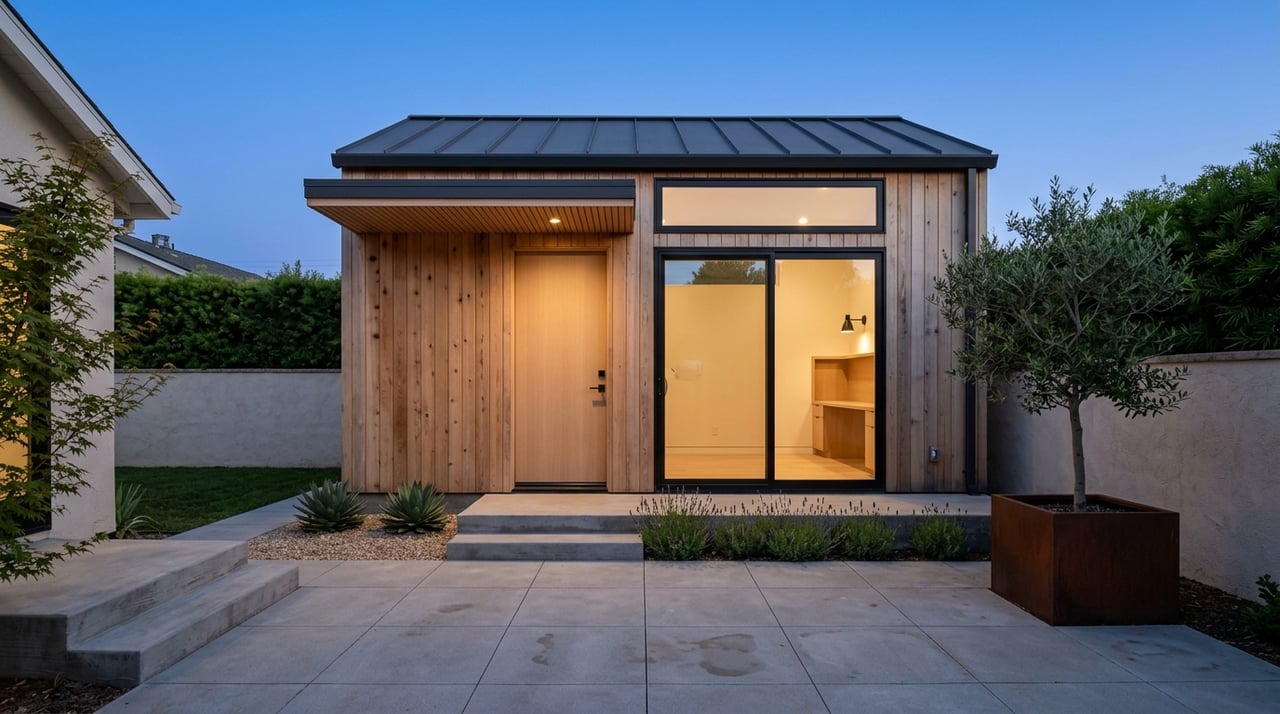
Thinking about adding an ADU to your Los Altos property? You are not alone. Many homeowners are exploring ADUs as a way to create space for family, support aging in place, add rental income, or carve out a separate home office without leaving the neighborhood they already love. If you are weighing whether an ADU makes sense for your lot, this guide will walk you through the basics, key Los Altos rules, and the practical factors that matter before you move forward. Let’s dive in.
What an ADU Means in Los Altos
In Los Altos, an accessory dwelling unit, or ADU, is a complete and independent dwelling located on the same lot as a single-family or multifamily residence. A junior accessory dwelling unit, or JADU, is smaller and must be created within a single-family home, with a maximum size of 500 square feet. The city outlines these definitions on its ADU program page.
For many homeowners, the appeal is simple. An ADU can create flexible living space without requiring a separate lot, which makes it useful for changing family needs and long-term planning. According to the California HCD ADU handbook, common benefits include housing for extended family, aging in place, and additional income.
Why Los Altos Owners Consider ADUs
Family flexibility and privacy
One of the biggest reasons homeowners add an ADU is to create space for multigenerational living. You may want a private place for relatives, adult children, or long-term guests while still keeping some separation between households. Both the city and the state describe ADUs as a practical tool for family housing and aging in place.
ADUs can also help you stay in Los Altos through different life stages. The city notes that an ADU may allow owners to downsize without leaving the community. That can be appealing if you love your location but want more flexibility in how your property works for you over time.
Rental income potential
Many homeowners also look at ADUs as a way to create long-term rental income. The City of Los Altos and the state both identify income as a common reason people build ADUs. Freddie Mac also notes that ADU rent may sometimes be used as qualifying income, depending on the financing scenario and loan guidelines.
That said, it is smart to treat income as a possible benefit, not a guarantee. Your results will depend on the legality of the unit, the design, the condition, and local demand.
Work-from-home space
If your household needs a separate office or studio, an ADU can solve a very practical problem. Freddie Mac points out that ADUs can provide dedicated work space for remote employees. In a market like Los Altos, that can be a meaningful alternative to buying a larger main house just to gain one extra room.
ADU Types to Compare
Before you think about finishes or construction costs, it helps to understand the three main formats.
Conversion ADUs
A conversion ADU is created inside existing living space or within an accessory structure. These projects can be attractive because the state says no setback is required when the ADU is created within an existing living area or accessory structure. On some lots, that can simplify the site-planning process.
Attached ADUs
An attached ADU is added onto the main house. According to the city’s ADU information handout, attached ADUs can be up to 1,200 square feet, but no more than 50 percent of the primary dwelling’s floor area. This option can work well if you want direct proximity to the main home.
Detached ADUs
A detached ADU is a separate structure, often in the backyard. Los Altos allows detached ADUs up to 1,200 square feet. This option often gives the most privacy, but it usually requires more site planning because you are dealing with placement, structure separation, utilities, grading, and drainage.
Los Altos Permit Rules to Know
Approval is ministerial
Los Altos states that ADU and JADU approvals are ministerial. In practical terms, that means you generally do not need a planning permit with public notice or a public hearing. The city says the primary approvals are a building permit and related permits.
State law also sets timing rules. Permit agencies must determine whether an application is complete within 15 business days, then approve or deny a complete application within 60 business days. You can review that framework through the city’s ADU page.
Setbacks and structure separation
Setbacks may be modest, but they still matter. The state handbook says side and rear setbacks for ADUs can be no more than four feet, and Los Altos lists four-foot side and rear setbacks in its guidance. The city also lists five feet of separation between structures.
These numbers can make a big difference on narrower or more constrained lots. Even when the basic setback rules seem simple, real feasibility still depends on the shape of your parcel and where existing structures, trees, and utilities sit.
Parking requirements can vary
Parking is one area where homeowners often get confused. Los Altos’ summary guide lists parking as required for attached and detached ADUs and not required for JADUs. At the same time, the state handbook says ADU parking requirements cannot exceed one space per unit or bedroom and are waived in several situations, including some units near transit or inside existing structures.
Because parking rules can depend on both unit type and site conditions, it is worth confirming the current standard before you finalize your plans.
Fees should be part of early planning
Fees can affect your project budget more than many homeowners expect. Under current state law, ADUs at or below 750 square feet and JADUs at or below 500 square feet are exempt from impact fees, while larger ADUs pay proportionate fees. Los Altos also notes in its submittal checklist that plan check fees are due when a complete application is accepted.
This is one reason smaller ADUs can be appealing. A compact footprint may support both faster decision-making and a simpler fee picture.
Permit-Ready Plans vs. Custom Design
Los Altos offers permit-ready detached ADU plans in three sizes, 525 square feet, 854 square feet, and 1,190 square feet, with three style options. The city says these plans are free of charge and include structural, mechanical, electrical, and plumbing drawings. They also cannot be modified.
For some homeowners, that is a major advantage. If your lot is straightforward and the available plans fit your goals, permit-ready plans may help simplify design decisions and shorten the path to permitting.
Custom plans may make more sense when your lot has constraints or unique opportunities. Based on the city’s current checklists, that can include mature trees, drainage issues, historic-resource review, creek proximity, or a tight building envelope. That is not a formal city rule, but it is a practical takeaway from the level of site-specific information Los Altos requires.
Site Planning Matters in Los Altos
What the city may ask for
Los Altos requires more than a sketch and a rough idea. The city’s ADU electronic submittal checklist calls for items such as:
- A dimensioned site plan
- Utility locations
- Creek or waterway locations within 50 feet
- A site survey from a licensed surveyor
- A tree protection plan
- Landscape and irrigation information
For attached or detached ADUs over 750 square feet, the checklist also calls for civil, grading, and drainage plans. That is a strong reminder that site planning is not just about where the unit fits. It is also about how the project performs on the lot.
Structural and environmental conditions
The same checklist flags local structural conditions, including seismic design category D/E and 110 mph windspeed. In plain terms, engineering is not something to leave until the last minute. Early professional input can help you avoid expensive redesigns later.
Additional review may also apply if your property is in a flood zone, appears on the Historic Resource Inventory, or sits within 50 feet of a creek, according to the city’s pre-application checklist. On these properties, a generic ADU concept may not tell you much until site-specific feasibility is reviewed.
How an ADU May Affect Value
Homeowners often ask whether an ADU will increase resale value. The careful answer is that it may, but there is no fixed formula. According to the FHFA analysis of California properties with ADUs, median appraised values for properties with ADUs rose from $550,000 in 2013 to $1.064 million in 2023, with faster annualized growth than comparable properties without ADUs.
A 2024 University of California Irvine study cited by FHFA also found that ADU presence in Los Angeles was associated with a 7 percent to 9 percent increase in assessed value and selling price. Even so, FHFA notes that more analysis is needed and that there can be tradeoffs, including infrastructure needs and maintenance costs.
For you as a homeowner, the practical takeaway is this: a permitted, well-integrated ADU may improve usefulness and marketability, but the value impact depends on legality, design quality, lot fit, and buyer demand. For future resale, an ADU may broaden appeal for buyers who want family flexibility, rental income, or separate workspace.
Smart Next Steps Before You Build
If you are in the early stages, a little upfront planning can save a lot of time and stress later.
Start with your goal
Ask yourself what job the ADU needs to do. Are you planning for family use, rental income, downsizing, guest space, or a home office? Your answer will shape the right size, layout, and placement.
Review the lot, not just the idea
Two homes on the same street can have very different ADU paths. Trees, drainage, utilities, creek proximity, structure placement, and lot dimensions can all affect feasibility. That is especially true in Los Altos, where site-specific submittal requirements are detailed.
Verify current rules
Because the state handbook has been updated with a 2026 addendum, it is wise to verify current city and state standards before moving from concept to design. Start with the Los Altos ADU page, and review the state’s current ADU handbook page.
Use local resources
Los Altos also points homeowners to Santa Clara County ADU resources for help with design, regulations, permits, costs, and rent-related information. If you are comparing whether to build, hold, or sell, that local context can be especially helpful.
If you are thinking about how an ADU fits into your long-term property plans, resale strategy, or a future move, working with a local advisor can help you look at the full picture, not just the construction idea. If you would like a thoughtful, property-specific conversation about how an ADU could affect usability and marketability, connect with Lynn North for a free consultation and home valuation.
FAQs
What is the difference between an ADU and a JADU in Los Altos?
- In Los Altos, an ADU is a complete independent dwelling on the same lot as a primary home, while a JADU is an interior unit within a single-family home that can be up to 500 square feet.
How large can an ADU be on a Los Altos property?
- Los Altos states that attached ADUs can be up to 1,200 square feet but no more than 50 percent of the main home’s floor area, and detached ADUs can also be up to 1,200 square feet.
Do Los Altos ADUs require a public hearing?
- No. Los Altos says ADU and JADU approvals are ministerial, so they do not require a planning permit with public notice or a public hearing.
Are impact fees required for every Los Altos ADU project?
- No. Under current state law, ADUs at or below 750 square feet and JADUs at or below 500 square feet are exempt from impact fees, while larger ADUs may have proportionate fees.
Can an ADU improve resale value on a Los Altos property?
- It may, but there is no guaranteed return. Research suggests ADUs can support value and marketability, especially when they are properly permitted and well integrated with the property.